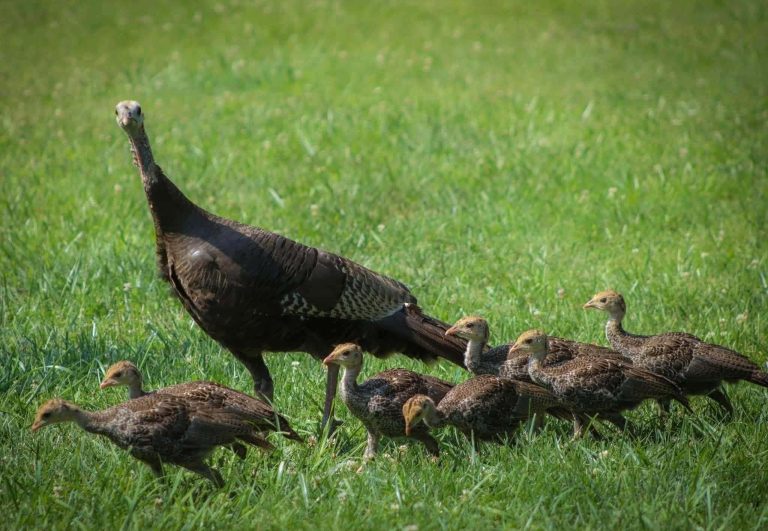
This Turkey Tuesday is about striking a balance – in this case, for broods after they hatch. When poults hatch, they remain at the nest for hours while the hen imprints them to herself, and during these hours poults gain the ability to walk and leave the nest site. As soon as practical, the hen moves the brood away from the nest to maximize their safety and find quality brooding areas with low growing vegetation – her strategy immediately changes from “hide at nest” to “find open ground with escape cover for poults”. Research has shown that hens will roost the brood > 200 yards away from the nest the 1st night after hatching, and she’ll move them >800 yards away from the nest within the first 3 days after hatching as she identifies appropriate vegetative communities to maximize the ability for poults to forage consistently, while minimizing movements and energy expenditure. But if she has to move the brood farther within that 1st 3 days, brood survival declines. What this balancing act looks like can be seen in the 2nd and 3rd images. The brood in the 2nd image hatches and you can see her linear path moving away from the nest – during that 1st 2 weeks after hatching she walks about ½ a mile, covers about 150 acres, then expands to use ~500 acres during the subsequent 2 weeks which is common for broods once they’re about 3 weeks old. But in the 3rd image, you see a problem – this hen moves the brood >2 miles during the 1st 2 weeks pointing to a lack of quality brood habitat. Poults on the move cannot forage as intensively as those who are able to concentrate their movements in small areas while the hen remains vigilant. The take home is, although poults out of both these broods survived, the fact that the movements depicted in the 3rd image occur regularly in our GPS-marked broods speaks to the need for improved quality and distribution of brood habitat across our landscapes. If you’re interested in recent works on brood movements, use the search function here on the site.
Pic of brood by Brian Machanic.